Published on 12/01/26
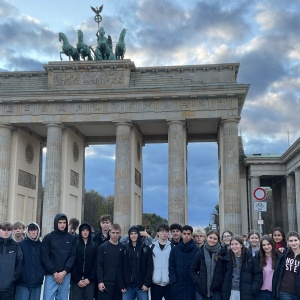
Year 12 students, Harry S, Seb H and Toby R tell us all about their History Trip to Berlin.
We arrived at the incredibly early time of 5am at Trumpington to travel to the airport, where we met our guide. This first day of the trip encompassed the flight from Stansted and involved sightseeing around the centre of Berlin.
Upon arrival, after leaving our luggage at the hostel, we walked around Berlin’s political centre - we saw the Reichstag, United Nations office, and other embassies and governmental buildings.
After exploring the city centre, where we tried the famous ‘Currywurst' for the first time, we visited the Memorial to the Roma and Sinti, a memorial to political prisoners, and most importantly, the Memorial to the Murdered Jews of Europe. There was a powerful and moving atmosphere as we walked throughout the monument, which our guide told us about, which encouraged some reflection on the tragedies of the Nazi regime and the victims of the Holocaust.
In the evening, we enjoyed a delicious chicken dinner, which was a nice end to a reasonably busy first day. Our accommodation at the hostel was also very pleasant — it was comfortable and well-organised by the teachers and guide, providing everything we needed for a relaxing stay.
On day two, we woke up bright and early and drove by coach for an hour or so to Sachsenhausen concentration camp. There, our guide told us about how the first few camps were set up in 1933 and how they were designed to scare the public as well as punish political opponents, and who was first imprisoned there. As we looked around the appalling living quarters of the prisoners, we were also told that often, many more people died of disease and starvation than by being killed by the Nazis.
The last, most notable stop on our tour was Station Z, which was used as a gas chamber in the middle of WW2. We learnt that the Nazis would send the enemies of the state from other countries they’d conquered to Station Z, and would disguise the room as a shower block, before killing them. For everyone there, it certainly was a sobering moment, and laid out the true cruelty of the regime, whilst also serving as a monument to those who died in that room.
After a hearty lunch at the cafe nearby, and a quick visit to the bookshop, we pressed on to Wannsee.
Our next part of the day was spent at Wannsee house, which is where high profile Nazis decided ‘The Final Solution to the Jewish Question’, which was to install gas chambers in numerous concentration camps. We had a good look around, and whilst the room where the meeting happened itself was closed, it was still fascinating to look around a house with such a rich history, and learn about the different people who attended the meeting there. We also paid a visit to the Topography of Terror, a museum about how the Nazis controlled the state, as well as taking a night-time trip back to the Reichstag building, and scaling up to the dome. The view was incredible and we got to learn a little about parliamentary history too!
We had dinner that day at a lovely pasta restaurant and went back to the hotel to enjoy our extra hour of sleep that evening (since the clocks were going back). On our final day, we woke again nice and early to spend the day learning about post-war Berlin and the divide between East and West.
Our first stop of the day was Bernauer Straße to visit the Conrad Schumann memorial and to learn how the GDR separated the East and West in heavily populated areas like this one. There we learned about Conrad Schumann, a young East-German guard who dared to jump over the barbed wire fence that separated the East and West. The photographer Peter Leibing was there and took the famous photo which would go on to symbolise the defiance against the East German regime.
After the memorial we went down the street, occasionally stopping to see the plaques on the floor to memorialise escape attempts made before the housing block got demolished. Our guide told us about Tunnel 57, which is when students dug a tunnel to help 57 people cross over from East to West Berlin.
Finally, after about an hour of tram riding and a 10-minute walk we reached the Stasi prison where people were sent to get information from them. Our tour guide for the prison, Andreas Ott, was very knowledgeable about the prison and its methods as he had spoken to many who were previously on remand there which allowed him to be very informed on the subject. We learnt that the Stasi often heavily relied on psychological torture to get information out of the prisoners, and designed prisons and the treatment there in order to break the spirits and minds of those imprisoned there.
Overall, we had a great time. We’ve learnt so much from our guide, not just about the general history of the city. What interested a lot of us on the trip was the stories of certain people in these times; it was fascinating to see how the actions of leaders like Ulbricht, Stalin and Hitler impacted everyday people. Of course, another major highlight was spending time with each other, and also the food, which was certainly delicious!
We want to thank Rob, our Anglia tour guide, for taking us around the city and giving us such insightful information and knowledge we can take forward in our future historical studies. We would also like to thank Mrs Stanley, Mrs Sefton and Ms Kedie for coming with us and organising such an amazing trip.